
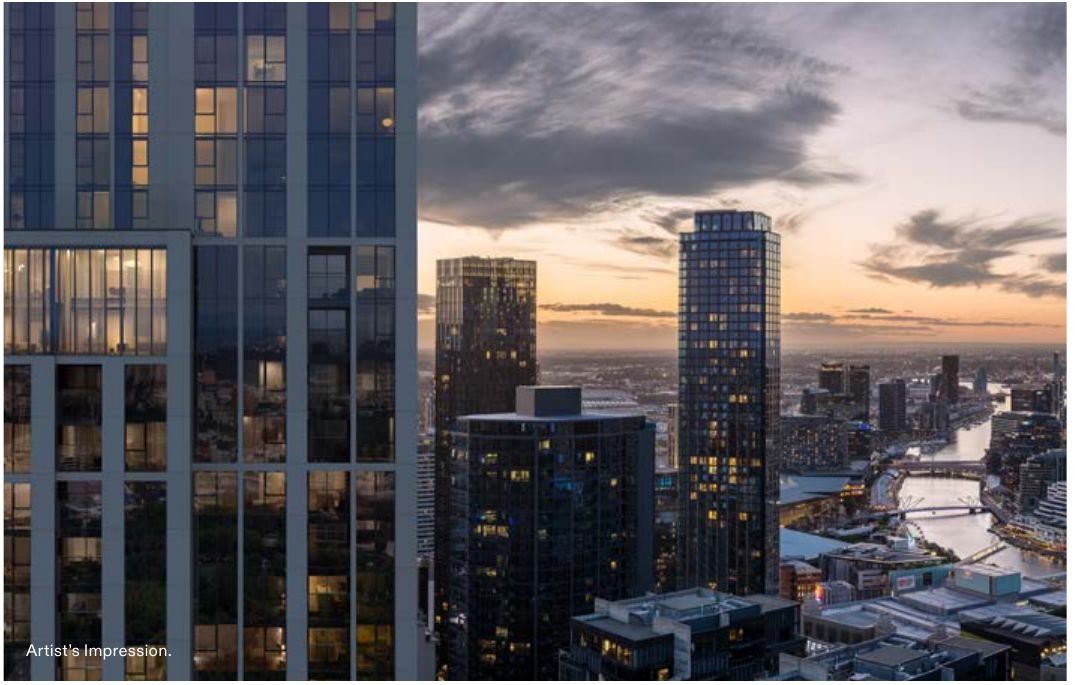
Australia. Melbourne's Southbank — and the only door still open to foreign buyers.
High-rise apartment living in Southbank, on the Yarra River in the heart of Melbourne, developer-direct — at a moment when Australia has closed established homes to foreign buyers until mid-2029, leaving new-build and off-plan as the primary route in.
WhatsApp · Typically replies within 2 hours
1
Developer Partners
1
Projects Listed
Jun 2029
Established-Dwelling Ban Until
AUD
Currency
Jump to Section
Why new-build is the practical route into Australia right now.
Australia has banned foreign persons from buying established dwellings from 1 April 2025 through 30 June 2029 — a window extended in the 2026-27 Budget, with only narrow exceptions such as redevelopments adding at least 20 new dwellings. New dwellings and vacant residential land remain open to foreign buyers, but every purchase still requires Foreign Investment Review Board (FIRB) approval and an application fee — around AUD $14,100 for a property valued at AUD $1,000,000 or less in 2026 — plus a state stamp duty surcharge on top of standard transfer duty: 8% in Victoria, where Melbourne sits. New Zealand citizens are the sole exemption from FIRB requirements. None of this is a reason to avoid the market — it is simply the shape of it: for a foreign buyer today, an off-plan apartment in a precinct like Southbank isn't a preference, it's close to the only door open at all.
Key Advantages
- Established (resale) dwellings closed to foreign buyers 1 April 2025 – 30 June 2029 — new dwellings and off-plan remain the open route
- FIRB approval required for every foreign purchase; application fee ~AUD $14,100 for properties ≤AUD $1,000,000 (2026)
- Victoria state stamp duty surcharge: 8% on top of standard transfer duty, applies in Melbourne
- New Zealand citizens are exempt from FIRB requirements — the only foreign nationality with this exemption
- Southbank is an established Melbourne CBD-fringe precinct on the Yarra River, not a fringe/emerging suburb
Australia — Investment Scorecard
Nine indicators rated 1–10 by the PropSentral research team. Updated quarterly.
Observed Gross Rental Yield Range
4% – 6.2%
Per annum, based on active listings. Not guaranteed.
Tax Summary
Income Tax
Non-residents pay Australian tax on rental income from the first dollar (no tax-free threshold): 30% up to A$135,000, 37% to A$190,000, 45% above
Capital Gains
Non-residents have not been entitled to the 50% CGT discount since 8 May 2012 — full gain is taxable. A Foreign Resident Capital Gains Withholding (FRCGW) of 15% of the sale price is withheld by the buyer at sale (a prepayment credited against final tax, not an extra tax)
Transfer Cost
Standard state stamp duty plus a foreign-buyer surcharge: 8% in Victoria (Melbourne), on top of standard transfer duty
Mortgage Access
Max LTV
Typically lower than for residents — non-resident foreign buyers commonly see 60–70% LVR caps, bank-dependent
Typical Rate
Broadly in line with standard Australian variable/fixed rates, though foreign-buyer-specific loan products can carry a premium
Notes
FIRB approval is required before a foreign person can even proceed with a purchase — factor the FIRB application fee and timeline into any purchase
Residency Pathway
Programme
No property-linked residency visa — Australia does not offer a golden-visa-style pathway; property purchase confers no migration benefit on its own
Threshold
N/A — property ownership does not confer residency
Timeframe
N/A for a standard property purchase
Australia is a materially higher-tax, lower-yield market for foreign non-resident investors than most others on this platform, with no residency pathway attached to property ownership and a currently-restricted resale market. Consult an Australian-licensed tax advisor and the FIRB directly before purchasing. Scores are qualitative assessments by PropSentral and should not be relied upon as financial advice.
Economic Intelligence
Macro Indicators — Australia
GDP growth, interest rate environment, currency trends, and tax impact for investors. Static data as of August 2026 (RBA rate); GDP data through 2024. Live charts sourced from BIS and FRED.
GDP Performance
Economic Output & Growth
USD billion. Source: World Bank / IMF (compiled).
2022
+3.9%
2023
+2%
2024
+1%
Interest Rate Environment
Central Bank Rate vs BBSW 3-Month
Reserve Bank of Australia (Cash Rate Target)
4.35%
BBSW 3-Month
4.35%
What is BBSW 3-Month?
The RBA cash rate target is the primary policy benchmark; Australian mortgage rates for foreign buyers are typically priced well above the cash rate given FIRB-related lending caution from most major banks toward non-resident borrowers.
⚠️ The RBA held its cash rate target at 4.35% as of 12 August 2026, following three consecutive rate rises earlier in 2026 — a tightening cycle, not an easing one, unlike several other markets on this platform. A full historical monthly series was not compiled for this market.
Currency
LiveExchange Rate — Your Currency vs AUD
Latest rate — Sept 26· FRED
1 USD = 0.8692 AUD
US Dollar → Australian Dollar
Monthly averages — Federal Reserve Economic Data (FRED), cross-rates computed from USD pairs. For illustrative purposes only. Exchange rates fluctuate — consult your bank or FX broker for transaction rates.
Tax Profile
Property Taxes — Australia
Established (resale) dwellings are closed to foreign buyers from 1 April 2025 through 30 June 2029 — new dwellings and off-plan remain the open route
FIRB (Foreign Investment Review Board) approval is required before a foreign person can proceed with a purchase — factor the application fee (~A$14,100 for properties ≤A$1,000,000 in 2026) and timeline into any purchase
New Zealand citizens are exempt from FIRB requirements — the only foreign nationality with this exemption
Tax information is general guidance only and may not reflect current legislation. Always consult a qualified local tax adviser before purchasing or selling property.
Lifestyle Intelligence
Living in Australia
Beyond the investment numbers — what does daily life actually cost, and what does it look like?
Cost of Living
Monthly Budget Estimates
Single Person
$2,200 – $3,200/mo
USD equivalent, including rent.
Couple
$3,500 – $5,200/mo
USD equivalent, including rent.
| Expense | Typical Range |
|---|---|
| Rent (1-bed) | AUD 2,000–3,200/mo (Southbank, CBD, Docklands) |
| Rent (3-bed) | AUD 3,800–6,500/mo (prime Melbourne areas) |
| Groceries | AUD 700–1,100/mo |
| Dining out | AUD 600–1,400/mo |
| Transport | AUD 200–450/mo (Myki public transport) · higher for car |
| Utilities | AUD 250–500/mo |
| Entertainment | AUD 500–1,200/mo |
| Health insurance | AUD 185–230/mo (private health insurance, age/coverage-dependent) |
A family of four in Melbourne budgets roughly AUD 8,000/month. Melbourne is genuinely expensive by global standards but offers Medicare-subsidised healthcare for residents, unlike most other markets on this platform.
Quality of Life
Lifestyle Scores
Safety
Crime rate, political stability, day-to-day security
Healthcare
Quality and accessibility of medical care
Climate
Weather, sunshine, and year-round liveability
Expat Community
Size and diversity of international resident base
Education
Quality and range of international schooling options
English Friendly
Daily life ease for English-only speakers
Education
Schools & Universities in Australia
Melbourne has a genuinely world-class education sector, home to some of Australia's oldest and most prestigious private schools alongside a growing international/bilingual school offering.
Available Curricula
Early Years (Ages 0–5)
A wide range of private and international early years programmes operate across Melbourne's inner and eastern suburbs.
Primary (Ages 5–11)
Melbourne Grammar School (founded 1858) and Wesley College (founded 1866) are among Australia's oldest and most prestigious schools.
Secondary (Ages 11–16)
Melbourne Grammar and Wesley College both extend through secondary with strong VCE/university placement records; Lycée International de Melbourne offers a French-medium bilingual pathway from Prep to Year 12.
Sixth Form / Pre-University (Ages 16–18)
VCE is the standard Victorian pathway to university; select schools also offer the IB Diploma as an alternative.
International Schools
Universities & Higher Education
Top Schools
Annual Fee Range
AUD 25,000 – 45,000 (private schools, indicative)
Healthcare
Medical Care in Australia
Australia's Medicare system provides free or heavily subsidised healthcare for citizens and permanent residents — but this platform's typical foreign buyer (non-resident, off-plan purchaser) does not automatically qualify, a genuine and important distinction from every other factor on this page.
Public System
Private System
Health Insurance
Specialist Access
Top Facilities
Insurance Cost
AUD 2,218–2,758 (individual, non-Medicare)
Residency & Retirement
Visa Pathways
Australia does not offer a golden-visa-style residency pathway — property ownership, including off-plan purchase, confers no migration benefit whatsoever. See this market's own residency summary.
Melbourne pairs world-class healthcare and education (for those with access) with one of the more expensive cost bases on this platform and zero property-linked residency pathway — a genuine lifestyle/investment market for those with independent means of qualifying to live in Australia, not a relocation-via-purchase market.
Why expats & retirees choose Australia
- University of Melbourne and Monash University are both globally top-100 institutions
- Melbourne Grammar School and Wesley College are among Australia's oldest and most prestigious schools
- World-class healthcare via Medicare for citizens/residents, and strong private options (Epworth, Royal Melbourne) otherwise
- No property-linked residency pathway exists at all — a genuine, important limitation relative to Gulf, Malaysian or Greek markets
- One of the more expensive cost bases on this platform, and Medicare access does not automatically extend to foreign off-plan buyers
Climate
Annual Weather — Australia
Melbourne has a genuinely temperate, changeable climate — famous locally for "four seasons in one day" — mild, warm (not hot) summers and cool, wet winters, a complete contrast to the tropical/desert climates of most other markets on this platform.
| Month | High °C | Low °C | Rain mm | Sun hrs/day | Humidity % |
|---|---|---|---|---|---|
| Jan | 26 | 14 | 50 | 8 | 52% |
| Feb | 26 | 14 | 45 | 7 | 55% |
| Mar★ | 24 | 13 | 50 | 6 | 58% |
| Apr | 20 | 10 | 55 | 5 | 63% |
| May | 17 | 8 | 50 | 4 | 68% |
| Jun▲ | 14 | 6 | 50 | 4 | 72% |
| Jul▲ | 13 | 5 | 50 | 4 | 72% |
| Aug | 15 | 6 | 50 | 5 | 68% |
| Sep | 17 | 7 | 55 | 6 | 62% |
| Oct | 20 | 9 | 65 | 6 | 58% |
| Nov★ | 22 | 11 | 60 | 7 | 55% |
| Dec★ | 24 | 12 | 55 | 8 | 53% |
Climate normals 1991–2020. ★ recommended months · ▲ peak heat / rain months.
Languages & Culture
Communication in Australia
Official Language(s)
English Proficiency
Very HighFor day-to-day expat navigation
Widely Spoken
Common Expat Languages
Business Language
English
English is the practical national language with no barrier of any kind for English-speaking buyers. Melbourne itself has one of Australia's most linguistically diverse populations, reflecting decades of migration from Southern Europe, East Asia and the Middle East.
Cost-of-living figures, named schools and hospitals are indicative and reviewed periodically, not live data — fees, admissions, accreditation and facility names can change. Confirm current details directly with the school or hospital, and current rent/cost figures with your PropSentral advisor, before relying on them for a relocation decision.
1 project on PropSentral
Loading map…
Click any pin to view project details. Map shows approximate locations.
Common questions about Australia
What is the cost of living in Australia for expats?
A single person typically budgets USD 2,200–3,200/month, and a couple USD 3,500–5,200/month, excluding property costs. A family of four in Melbourne budgets roughly AUD 8,000/month. Melbourne is genuinely expensive by global standards but offers Medicare-subsidised healthcare for residents, unlike most other markets on this platform.
What are the best international schools in Australia?
Leading options include Melbourne Grammar School, Wesley College, Lycée International de Melbourne. Melbourne has a genuinely world-class education sector, home to some of Australia's oldest and most prestigious private schools alongside a growing international/bilingual school offering.
What are the top hospitals and healthcare facilities in Australia?
Leading facilities include Royal Melbourne Hospital, Epworth Hospital, St Vincent's Hospital Melbourne. Australia's Medicare system provides free or heavily subsidised healthcare for citizens and permanent residents — but this platform's typical foreign buyer (non-resident, off-plan purchaser) does not automatically qualify, a genuine and important distinction from every other factor on this page.
Can foreigners get residency in Australia by buying property?
No property-linked residency visa — Australia does not offer a golden-visa-style pathway; property purchase confers no migration benefit on its own. Threshold: N/A — property ownership does not confer residency. N/A for a standard property purchase
What is the typical rental yield in Australia?
Gross rental yields typically range 4–6.2% per annum based on active listings on PropSentral. This is indicative, not a guarantee — see this market's own investment intelligence section for the full breakdown.
Is there capital gains tax on property in Australia?
Non-residents have not been entitled to the 50% CGT discount since 8 May 2012 — full gain is taxable. A Foreign Resident Capital Gains Withholding (FRCGW) of 15% of the sale price is withheld by the buyer at sale (a prepayment credited against final tax, not an extra tax)
What is the climate like in Australia?
Melbourne has a genuinely temperate, changeable climate — famous locally for "four seasons in one day" — mild, warm (not hot) summers and cool, wet winters, a complete contrast to the tropical/desert climates of most other markets on this platform. Best months to visit: Nov, Dec, Mar.
What languages are spoken in Australia?
The official language is English (de facto; no official federal language). English is the practical national language with no barrier of any kind for English-speaking buyers. Melbourne itself has one of Australia's most linguistically diverse populations, reflecting decades of migration from Southern Europe, East Asia and the Middle East.
Answers are indicative, based on PropSentral's own market data and general guidance — always confirm current rates, fees and eligibility with a qualified local adviser before acting.
On This Page
Ready to invest in Australia?
Browse developer-direct off-plan apartment projects in Melbourne's Southbank precinct. Compare unit types and amenities — then speak with a PropSentral advisor about FIRB approval and the current foreign-buyer rules.
WhatsApp · Typically replies within 2 hours