
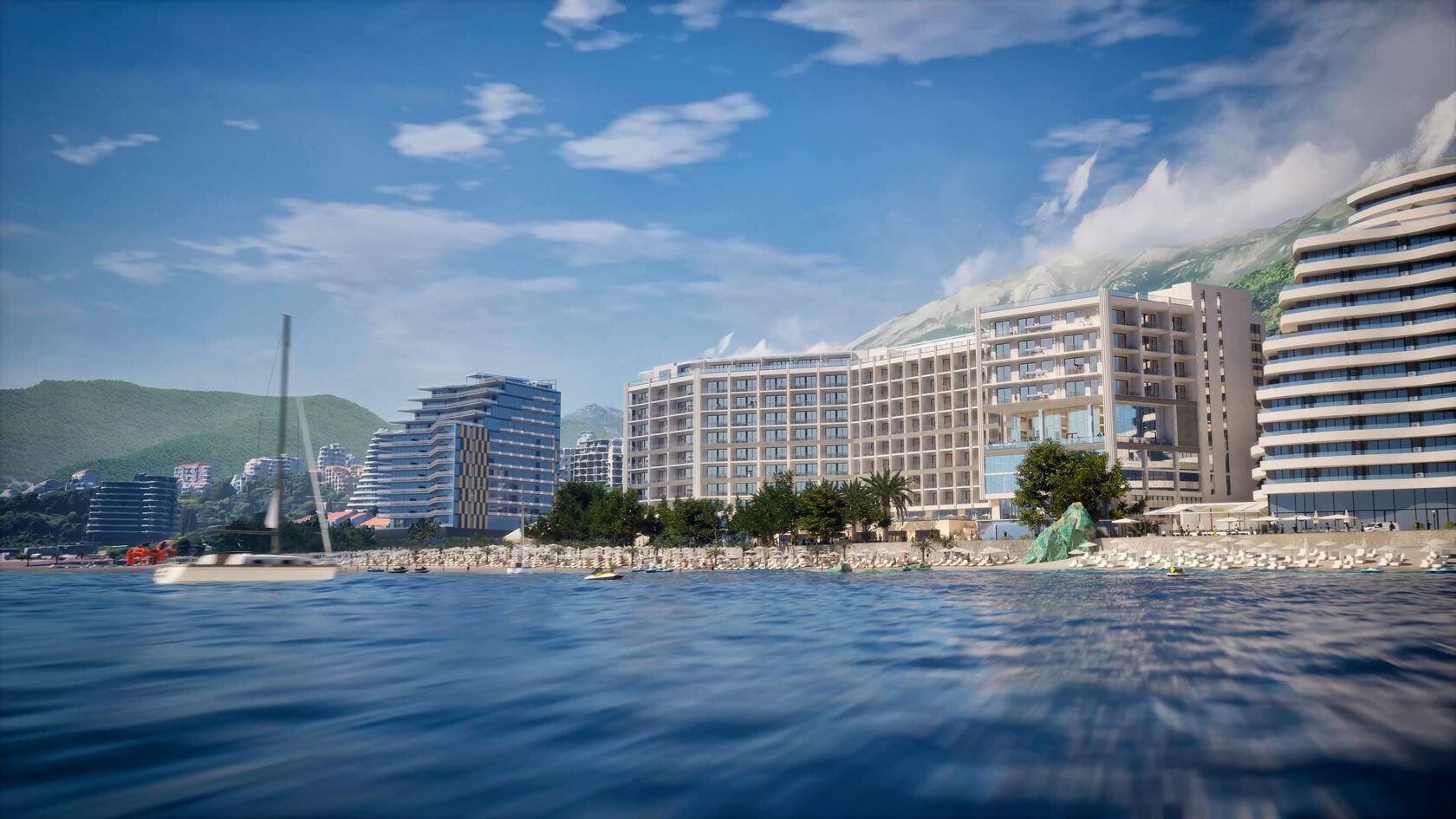
Montenegro. Budva's Adriatic waterfront, branded by Meliá.
Meliá Private Residences Budva — 136 branded residences developed by SUNRAF with Meliá Hotels International as 15-year hotel operator, from €263,000.
WhatsApp · Typically replies within 2 hours
1
Developer Partners
1
Projects Listed
€263,000
Starting Price
€150K
Residency Threshold
Jump to Section
A new Adriatic market, built on a public-information basis — flagged honestly.
Montenegro is PropSentral's newest market, entered through Meliá Private Residences Budva — a 136-unit branded residential development on the Budva waterfront, developed by SUNRAF (30+ years, 1 million m²+ delivered across Montenegro and Europe) under a 15-year hotel management agreement with Meliá Hotels International. Montenegro itself is a genuinely unusual case on this platform: it unilaterally uses the Euro without being an EU or Eurozone member, and its 2026 property-based residency rules now require a minimum official (government-assessed) taxable property value of €150,000 for a renewable 1-year temporary residence permit — a real tightening from earlier, looser rules, and distinct from Montenegro's EU-style citizenship-by-investment programme, which closed in December 2022 and has not been replaced. Unlike every other listing on this platform, this one was built from the developer's own public website rather than a shared factsheet or floor-plan document, because no downloadable materials pack was available — so treat the figures here as a useful starting point, not Baytech-verified developer documentation, and reconfirm directly before relying on them.
Key Advantages
- Meliá Private Residences Budva: 136 units (studio to 3-bedroom), starting from €263,000, on the Budva Adriatic waterfront
- Developed by SUNRAF, with Meliá Hotels International as hotel operator under a 15-year management agreement — not the developer of record
- Optional owner rental programme: 70/30 revenue split with Meliá, plus a 10% discount on resort facilities
- Montenegro's 2026 property-based residency threshold is €150,000 of official assessed value — a 1-year renewable permit, not citizenship
- Built from the developer's public website, not a shared documents pack — this listing's facts are flagged as lower-confidence than the rest of the platform until independently verified
Montenegro — Investment Scorecard
Nine indicators rated 1–10 by the PropSentral research team. Updated quarterly.
Observed Gross Rental Yield Range
5% – 7%
Per annum, based on active listings. Not guaranteed.
Tax Summary
Income Tax
Rental income is taxed at 15% for individuals — reconfirm current treatment with a Montenegro-licensed tax advisor
Capital Gains
No capital gains tax after 2 years of ownership; a flat 9% applies to the net gain on sales within the first 2 years
Transfer Cost
Progressive real estate transfer tax: 3% up to €150,000; €4,500 + 5% on the amount between €150,001–€500,000; €22,000 + 6% above €500,000. New-build purchases are typically VAT-inclusive instead of transfer tax
Mortgage Access
Max LTV
30–50% for non-resident foreign buyers, depending on the bank — meaningfully more restrictive than for Montenegrin residents
Typical Rate
5–7% effective annual interest for foreign buyers (2026)
Notes
CKB, Erste Bank Montenegro and Hipotekarna Banka are the most active lenders to foreign buyers; most foreign buyers put down 50–70% of the purchase price
Residency Pathway
Programme
1-year renewable temporary residence permit by property purchase
Threshold
€150,000 minimum official (government-assessed) taxable property value — not the purchase price or agent brochure figure
Timeframe
Renewable annually; the property must be free of mortgages, liens and legal disputes. Montenegro’s earlier EU-style golden-passport citizenship-by-investment programme closed in December 2022 and has not been replaced
Montenegro facts on this page are compiled from public sources, not a licensed Montenegro tax or immigration advisor, and this listing itself was built from the developer’s public website rather than a shared documents pack — reconfirm current thresholds, rates, mortgage terms and project facts directly before relying on them, especially given the 2026 residency-threshold change. Scores are qualitative assessments by PropSentral and should not be relied upon as financial advice.
Economic Intelligence
Macro Indicators — Montenegro
GDP growth, interest rate environment, currency trends, and tax impact for investors. Static data as of GDP and growth data through 2025 (World Bank); 2024–2025 nominal GDP figures are approximate compiled estimates. Tax and residency rules as researched October 2026.. Live charts sourced from BIS and FRED.
GDP Performance
Economic Output & Growth
USD billion (approximate — nominal figures for 2024–2025 are estimated by compounding the 2023 base with World Bank real-growth rates, not independently sourced nominal figures). Source: World Bank (compiled, approximate).
2023
+6%
2024
+3%
2025
+2.7%
Interest Rate Environment
Central Bank Rate vs EURIBOR 12-Month
European Central Bank (ECB Deposit Rate)
2.25%
EURIBOR 12-Month
2.30%
What is EURIBOR 12-Month?
Montenegro unilaterally adopted the Euro in 2002 without joining the EU or Eurozone — it has no seat on the ECB Governing Council and no lender-of-last-resort backstop, but ECB rates and EURIBOR are still the practical reference for any Euro-denominated financing available locally.
⚠️ Foreign buyers typically borrow from Montenegro-based banks (CKB, Erste Bank Montenegro, Hipotekarna Banka) at a flat quoted rate rather than a EURIBOR-linked variable rate — the ECB/EURIBOR series above is shown as the regional Euro-rate benchmark, not a confirmed local mortgage index. Confirm actual loan pricing directly with a Montenegro-based bank.
Currency
LiveExchange Rate — Your Currency vs EUR
Montenegro unilaterally uses the Euro as its official currency without being an EU or Eurozone member — a genuinely unusual arrangement (sometimes called "euroization") shared with only a few other territories worldwide.
Latest rate — Sept 26· FRED
1 USD = 0.8692 EUR
US Dollar → Euro
Monthly averages — Federal Reserve Economic Data (FRED), cross-rates computed from USD pairs. For illustrative purposes only. Exchange rates fluctuate — consult your bank or FX broker for transaction rates.
Tax Profile
Property Taxes — Montenegro
Montenegro’s EU-style citizenship-by-investment (golden passport) programme closed in December 2022 and has not been replaced
The property-based temporary residence permit threshold rose to €150,000 of official (government-assessed) taxable value in 2026 — a real tightening from earlier rules
All figures above are compiled from public sources, not a licensed Montenegro tax advisor — reconfirm before relying on them
Tax information is general guidance only and may not reflect current legislation. Always consult a qualified local tax adviser before purchasing or selling property.
Lifestyle Intelligence
Living in Montenegro
Beyond the investment numbers — what does daily life actually cost, and what does it look like?
Cost of Living
Monthly Budget Estimates
Single Person
$1,400 – $2,400/mo
USD equivalent, including rent.
Couple
$2,200 – $3,600/mo
USD equivalent, including rent.
| Expense | Typical Range |
|---|---|
| Rent (1-bed) | €500–800/mo off-season, €700–1,200/mo peak summer (Budva) |
| Rent (3-bed) | €900–1,800/mo, higher in peak summer season |
| Groceries | €180–280/mo per person |
| Dining out | €150–350/mo |
| Transport | €40–100/mo (car recommended along the coast) |
| Utilities | €100–220/mo (higher with AC in summer) |
| Entertainment | €100–250/mo |
| Health insurance | €30–80/mo (private health insurance) |
Budva and the wider Montenegrin coast cost roughly 20–40% more in peak summer than off-season, a genuinely large seasonal swing worth budgeting for explicitly. Even at summer peak, costs remain below most Western European and North American coastal destinations.
Quality of Life
Lifestyle Scores
Safety
Crime rate, political stability, day-to-day security
Healthcare
Quality and accessibility of medical care
Climate
Weather, sunshine, and year-round liveability
Expat Community
Size and diversity of international resident base
Education
Quality and range of international schooling options
English Friendly
Daily life ease for English-only speakers
Education
Schools & Universities in Montenegro
The Montenegrin coast has a small but growing international school sector, concentrated around Tivat and Kotor rather than Budva itself.
Available Curricula
Early Years (Ages 0–5)
Both Knightsbridge (Tivat) and Arcadia Academy (Kotor) run early-years programmes from age 3.
Primary (Ages 5–11)
Knightsbridge Schools International, Tivat — Montenegro’s leading IB World School, serving ages 3–18.
Secondary (Ages 11–16)
Arcadia Academy, Kotor — a full COBIS member and Montenegro’s only Cambridge International school, ages 3–18.
Sixth Form / Pre-University (Ages 16–18)
Knightsbridge offers the full IB Diploma Programme; Arcadia Academy offers Cambridge A Levels.
International Schools
Universities & Higher Education
Top Schools
Annual Fee Range
EUR 7,000 – 14,000
Healthcare
Medical Care in Montenegro
Private clinics serving expats and foreign residents are concentrated in the coastal towns of Budva, Kotor and Tivat, alongside the capital Podgorica.
Public System
Private System
Health Insurance
Specialist Access
Top Facilities
Insurance Cost
USD 400–1,200 (individual, basic private coverage)
Residency & Retirement
Visa Pathways
No dedicated retirement visa; the same €150,000 property-based temporary residence permit (renewable annually) is the main property-linked route for retirees, as for other buyers.
The Montenegrin coast is meaningfully cheaper than Western Europe outside peak summer, with a large seasonal cost swing (roughly 20–40% higher in July–August) worth budgeting for explicitly.
Why expats & retirees choose Montenegro
- A genuinely excellent Mediterranean climate and coastline, with Budva as one of the Adriatic’s established resort towns
- Montenegro uses the Euro, removing currency-conversion complexity for Eurozone-based buyers, despite not being an EU or Eurozone member itself
- A real, if recently tightened, property-based residency route (€150,000 minimum assessed value, from 2026)
- International schooling is thin directly in Budva — Knightsbridge (Tivat) and Arcadia Academy (Kotor) are each a 30–45 minute coastal drive away
- A small, still-developing expat and developer ecosystem relative to more established Mediterranean markets like Spain or Cyprus — a real tradeoff for the lower cost base
Climate
Annual Weather — Montenegro
Budva has a classic Adriatic Mediterranean climate: a long, dry, hot summer and a mild but genuinely rainy winter — annual rainfall (around 1,930mm) is considerably higher than drier Mediterranean markets like Spain's Costa del Sol, concentrated mostly from October through December.
| Month | High °C | Low °C | Rain mm | Sun hrs/day | Humidity % |
|---|---|---|---|---|---|
| Jan | 13 | 6 | 210 | 4 | 68% |
| Feb | 14 | 6 | 180 | 5 | 66% |
| Mar | 16 | 8 | 150 | 6 | 65% |
| Apr | 19 | 11 | 120 | 7 | 64% |
| May★ | 24 | 15 | 75 | 9 | 62% |
| Jun★ | 28 | 18 | 40 | 11 | 58% |
| Jul★ | 30 | 21 | 20 | 12 | 55% |
| Aug★ | 30 | 21 | 30 | 11 | 58% |
| Sep★ | 27 | 18 | 100 | 8 | 63% |
| Oct★ | 23 | 14 | 220 | 6 | 66% |
| Nov | 19 | 11 | 310 | 4 | 70% |
| Dec | 14 | 7 | 275 | 4 | 70% |
Avg high/low temperatures: climate normals 1991–2020 (climate-data.org). Rainfall distribution, sun hours and humidity are approximate, modelled on the known annual total and November peak rather than independently sourced per month.. ★ recommended months · ▲ peak heat / rain months.
Languages & Culture
Communication in Montenegro
Official Language(s)
English Proficiency
MediumFor day-to-day expat navigation
Widely Spoken
Common Expat Languages
Business Language
Montenegrin / Serbian, with English common in tourism, hospitality and real estate
Montenegrin is written in both Latin and Cyrillic scripts, though Latin dominates day-to-day and commercial use. Real estate contracts and legal documents are typically drafted in Latin-script Montenegrin, with English translations common for foreign buyers.
Montenegrin, Serbian, Bosnian and Croatian are mutually intelligible South Slavic languages, so day-to-day communication is genuinely easier across the wider region than the four-language framing suggests. Russian is widely spoken among property buyers and long-term residents on the coast, reflecting a long-established Russian buyer community; English is common in tourism and hospitality but less so in government and legal processes.
Cost-of-living figures, named schools and hospitals are indicative and reviewed periodically, not live data — fees, admissions, accreditation and facility names can change. Confirm current details directly with the school or hospital, and current rent/cost figures with your PropSentral advisor, before relying on them for a relocation decision.
1 project on PropSentral
Loading map…
Click any pin to view project details. Map shows approximate locations.
Common questions about Montenegro
What is the cost of living in Montenegro for expats?
A single person typically budgets USD 1,400–2,400/month, and a couple USD 2,200–3,600/month, excluding property costs. Budva and the wider Montenegrin coast cost roughly 20–40% more in peak summer than off-season, a genuinely large seasonal swing worth budgeting for explicitly. Even at summer peak, costs remain below most Western European and North American coastal destinations.
What are the best international schools in Montenegro?
Leading options include Knightsbridge Schools International (Tivat), Arcadia Academy (Kotor). The Montenegrin coast has a small but growing international school sector, concentrated around Tivat and Kotor rather than Budva itself.
What are the top hospitals and healthcare facilities in Montenegro?
Leading facilities include Medical Centar Budva, Poliklinika Sveti Luka (Budva), Milmedika Polyclinic (Tivat). Private clinics serving expats and foreign residents are concentrated in the coastal towns of Budva, Kotor and Tivat, alongside the capital Podgorica.
Can foreigners get residency in Montenegro by buying property?
1-year renewable temporary residence permit by property purchase. Threshold: €150,000 minimum official (government-assessed) taxable property value — not the purchase price or agent brochure figure. Renewable annually; the property must be free of mortgages, liens and legal disputes. Montenegro’s earlier EU-style golden-passport citizenship-by-investment programme closed in December 2022 and has not been replaced
What is the typical rental yield in Montenegro?
Gross rental yields typically range 5–7% per annum based on active listings on PropSentral. This is indicative, not a guarantee — see this market's own investment intelligence section for the full breakdown.
Is there capital gains tax on property in Montenegro?
No capital gains tax after 2 years of ownership; a flat 9% applies to the net gain on sales within the first 2 years
What is the climate like in Montenegro?
Budva has a classic Adriatic Mediterranean climate: a long, dry, hot summer and a mild but genuinely rainy winter — annual rainfall (around 1,930mm) is considerably higher than drier Mediterranean markets like Spain's Costa del Sol, concentrated mostly from October through December. Best months to visit: May, Jun, Jul, Aug, Sep, Oct.
What languages are spoken in Montenegro?
The official language is Montenegrin. Montenegrin, Serbian, Bosnian and Croatian are mutually intelligible South Slavic languages, so day-to-day communication is genuinely easier across the wider region than the four-language framing suggests. Russian is widely spoken among property buyers and long-term residents on the coast, reflecting a long-established Russian buyer community; English is common in tourism and hospitality but less so in government and legal processes.
Answers are indicative, based on PropSentral's own market data and general guidance — always confirm current rates, fees and eligibility with a qualified local adviser before acting.
On This Page
Ready to invest in Montenegro?
Browse Meliá Private Residences Budva, PropSentral's first Montenegro listing — then speak with an advisor about the Adriatic coast's property-based residency route.
WhatsApp · Typically replies within 2 hours